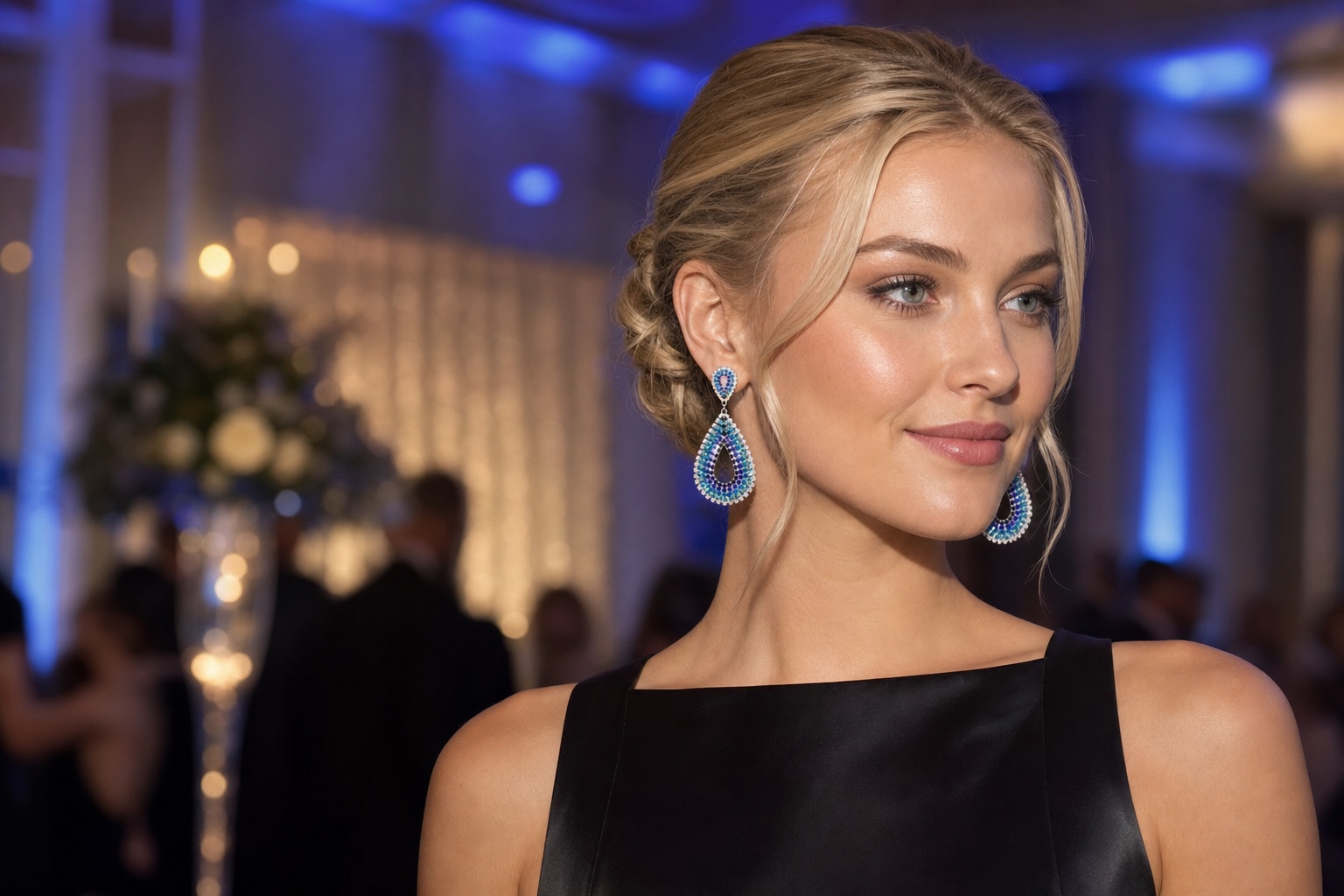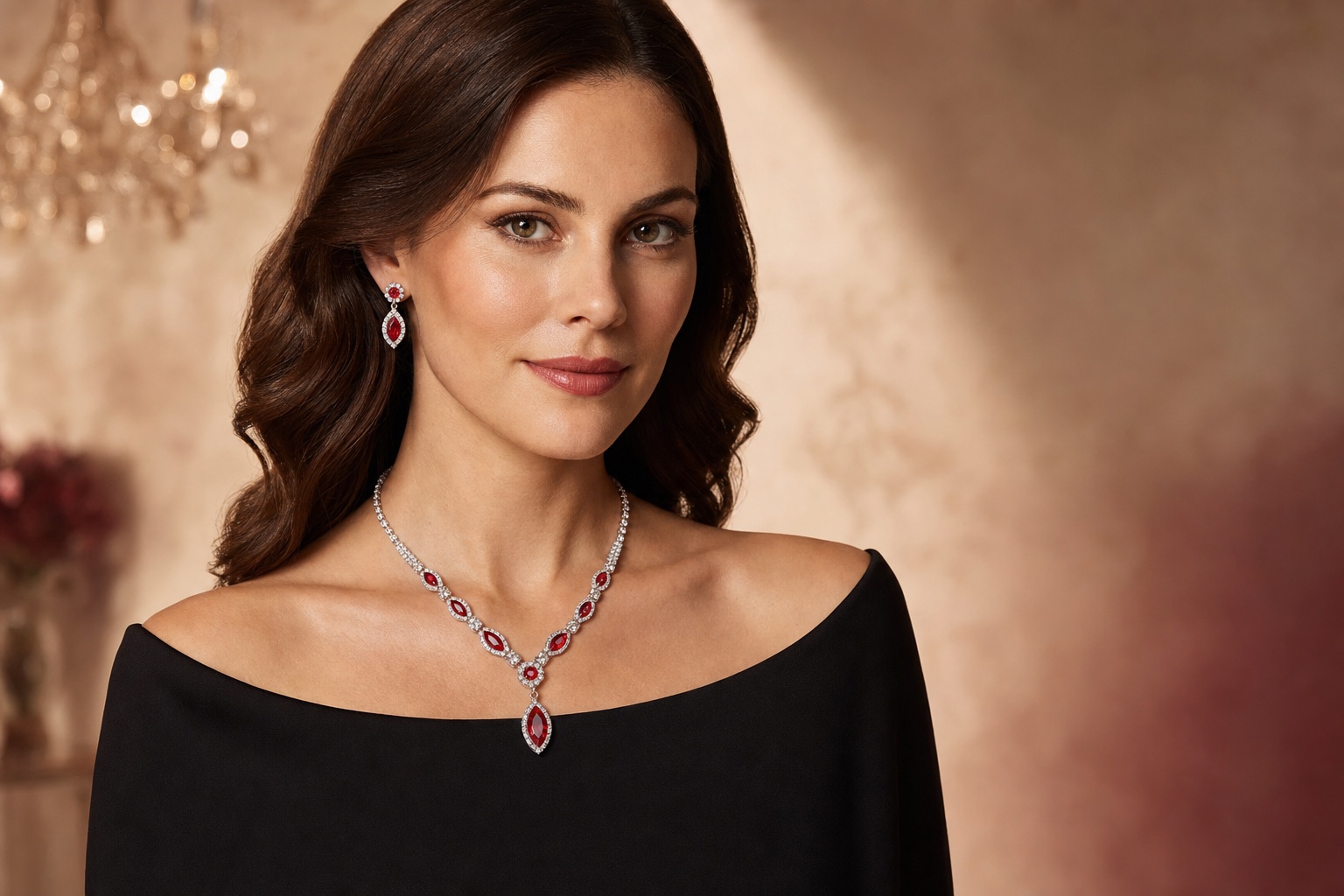
Most neckline-and-jewelry advice is written as a list of rules: wear this necklace with that dress. A boutique needs something more useful. It needs enough coverage to help different customers, product dimensions that can be checked, and a way to see whether the combination works on the actual garment.
The neckline is important because it changes the open area around the face and chest, but it is not the only input. Hairstyle, dress embellishment, shoulder detail, wearer preference, jewelry scale, and movement can overturn a tidy rule.
The Knot’s current bridal guidance likewise starts with the design of the clothing and treats personal style as decisive rather than requiring one universal match (source). For a wholesale buyer, that principle becomes a matrix and a sample test.
Describe the geometry before naming a product
Record four observable properties:
- Open area: How much uninterrupted skin or fabric is available around the neckline?
- Direction: Does the neckline create a vertical, horizontal, curved, angular, or asymmetrical line?
- Edge detail: Is the edge plain, ruched, beaded, laced, ruffled, folded, or dimensional?
- Competing features: Are there straps, sleeves, a collar, a bow, a brooch, or prominent dress stones near the jewelry area?
This description is more reliable than a neckline label alone. Two “sweetheart” dresses can have different depths, strap placements, and embellishment. A product recommendation should survive contact with the real dress.
Buyer matrix by neckline family
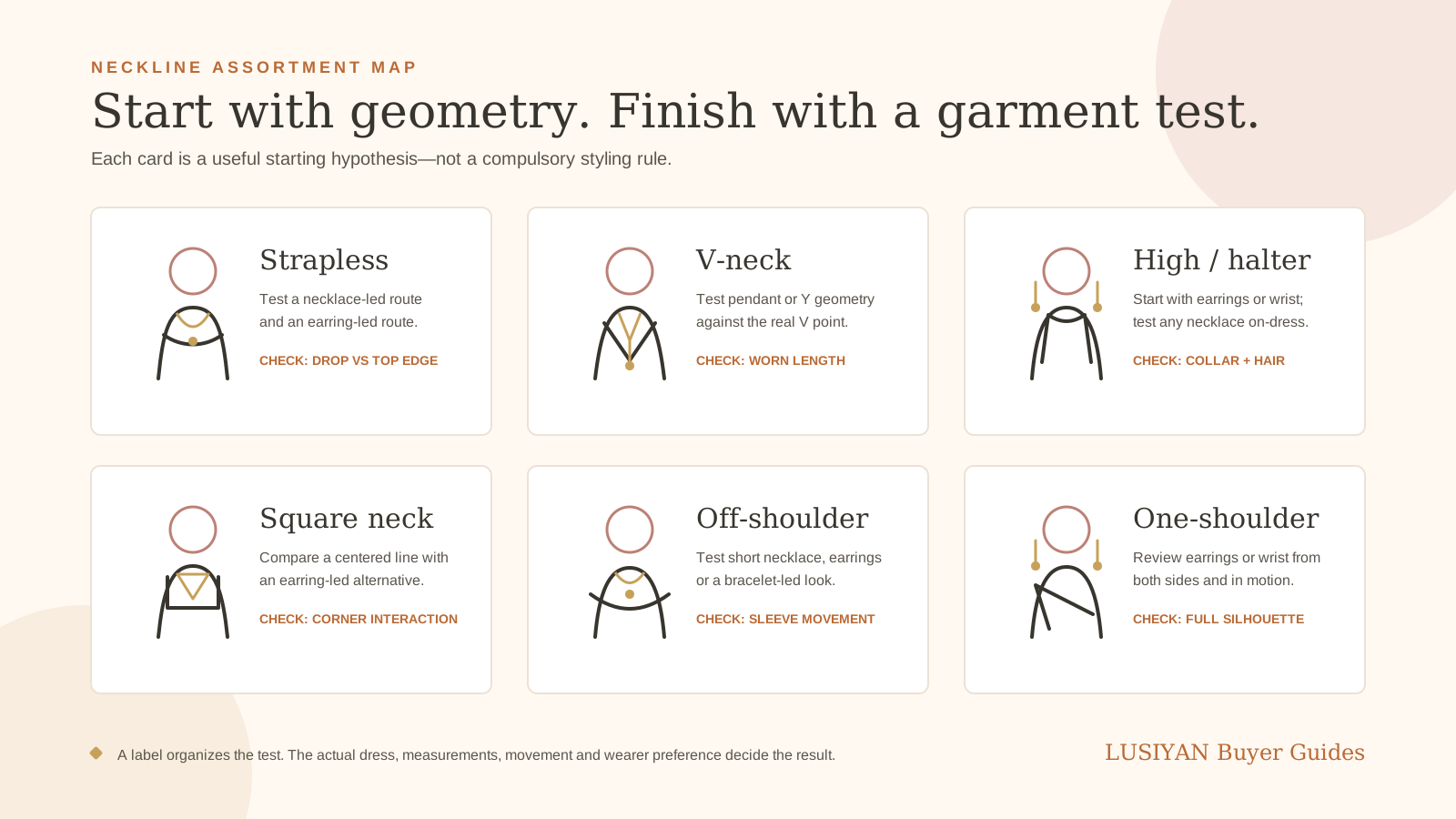
The table below offers test directions, not dress rules.
| Neckline family | Useful assortment directions | What to measure or test | Common buying error |
|---|---|---|---|
| Strapless | Short necklace, collar-like line, pendant, earring-led alternative | Necklace drop against top edge; full-silhouette balance | Buying many similar necklace sets but no quiet alternative |
| Sweetheart | Curved or centered necklace; pendant/Y option where depth allows; earrings-only option | Whether the necklace enters, echoes, or sits above the curve | Assuming all sweetheart depths are the same |
| V-neck / plunge | Pendant or Y geometry; compact drop earrings; earrings-only statement | Pendant drop versus V point; movement and modesty insert | Choosing from a flat lay without worn length |
| Square neck | Short centered line, geometric pendant, earrings-led option | Corner/edge interaction; width and drop | Treating “geometric” as a guarantee of harmony |
| Off-shoulder | Short necklace, defined earrings, bracelet-led option | Interaction with sleeve/ruffle; shoulder movement | Overfilling the horizontal open area |
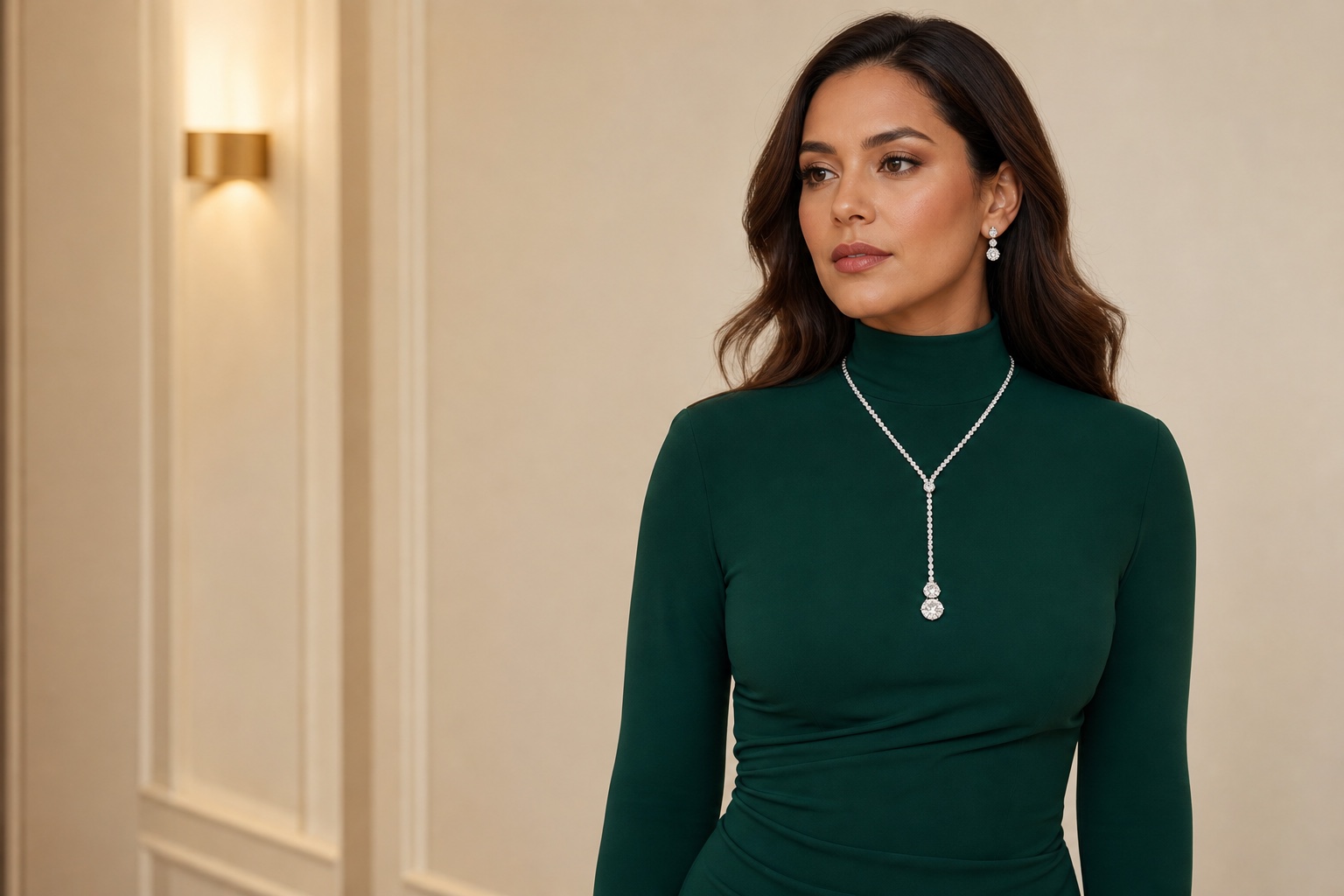
| High neck / halter | Earrings and bracelet; necklace only after garment test | Hair, collar, strap, and earring movement | Ordering necklace sets because the category feels complete |
| One-shoulder / asymmetrical | Earrings, bracelet, or intentionally asymmetric styling | Full look from both sides and in motion | Applying a mirrored rule to an asymmetric dress |
| Scoop / bateau | Short-to-medium necklace or earring-led option depending on edge | Necklace curve/width; fabric overlap | Ignoring a heavily embellished edge |
The assortment does not need every possible combination. It needs a deliberate answer for the necklines that matter in the store.
Audit neckline coverage from the dress buy
Create a dress-neckline report from current receipts and reservations. Normalize labels first: off shoulder and off-shoulder should not become separate demand categories.
Then build a coverage table:
| Neckline | Dress units or appointments | Quiet jewelry option | Defined option | Statement option | Gap/action |
|---|---|---|---|---|---|
| Strapless | |||||
| Sweetheart | |||||
| V-neck | |||||
| High neck / halter | |||||
| Off-shoulder | |||||
| Square | |||||
| Asymmetrical |
The first numeric column must come from the boutique, not a supplier catalog. LUSIYAN’s own product tags describe catalog compatibility; they are not evidence of what shoppers will request. The broader wholesale prom jewelry buying guide shows how this table fits into a complete opening-order brief.
Normalize the neckline data first
Before counting, create one controlled label for each family and retain the source label separately. V neck, V-neck, and plunge V may share a family while still needing a depth attribute. Off shoulder and one shoulder should not be merged merely because both expose the shoulder area.
A compact data dictionary can include:
| Field | Controlled value | Optional qualifier |
|---|---|---|
| Neckline family | strapless, sweetheart, V, square, off-shoulder, one-shoulder, high/halter, scoop/bateau | depth, width, strap/sleeve detail |
| Edge detail | plain, beaded, lace, ruffle, fold, appliqué | location and density |
| Open-area estimate | low, medium, high | based on an agreed dress-photo view |
| Necklace feasibility | yes, conditional, not ranged | reason and test image |
This prevents an SEO slug or supplier tag from becoming a technical garment specification.
Require measurements that make matching possible
A product title such as “Y necklace” is not enough. For necklaces, request and record:
- wearable chain length at minimum and maximum settings;
- vertical decorative drop;
- maximum decorative width;
- center motif dimensions;
- extender length and usable attachment points;
- clasp type and component weight;
- whether measurements include the clasp or pendant.
For earrings, record length from the piercing point—not merely the decorative component—plus maximum width and weight per earring. For bracelets, define the inner circumference or usable length and the closure adjustment range.
Use annotated photographs that show the measurement datum points. Keep a reusable measurement sheet with the original image, measurement lines, units, revision date and the name of the person or supplier who supplied each value.
Test the combination at three distances
A close product photograph rewards detail. A fitting-room mirror and event photograph reward the whole composition.
Review each candidate at:
- inspection distance: construction, finish, edges, closure, stone alignment;
- conversation distance: face, neckline, jewelry, and dress detail together;
- full-silhouette/phone distance: whether the intended focal point remains visible.
Also record movement. A pendant that aligns perfectly in a still image may rotate, fall inside the dress, or cross the neckline edge during normal wear.
Use an “emphasis budget”
One practical way to avoid over-assorting complete sets is to give each look an emphasis budget.
- Quiet: supports the dress with low visual contrast or compact scale.
- Defined: clearly visible but shares attention with the dress.
- Statement: intended to be a principal focal point.
The labels describe visual role, not price or quality. A small, precisely constructed piece can be premium; a large piece can be inexpensive. They also should not become fixed customer categories. Let a customer move among them.
Account for hair, sleeves, and comfort
Neckline planning can overfocus on necklaces. Ask:
- Will the hair be up, down, or undecided?
- Do long earrings contact the shoulder, collar, or hair?
- Does a bracelet catch lace, mesh, gloves, or a beaded sleeve?
- Can the wearer operate the clasp?
- Does the necklace extender irritate or remain visible at the back?
- Has the relevant material/safety documentation been obtained for the intended market?
Never turn a visual inspection into a sensitivity claim. “Looks nickel-free” is not evidence.
Know when not to range a necklace
Completeness does not require a necklace for every dress. A deliberate not ranged decision may be appropriate when the store’s high-neck dresses dominate, edge embellishment occupies the same area, available samples do not sit correctly, or the supporting dimensions are incomplete.
Record the reason. Otherwise a future buyer may read an empty cell as an oversight and reorder the same mismatch. The alternative can be an earring-, bracelet-, hair-accessory-, or minimal route, provided that product and intended-use evidence is complete.
Merchandise alternatives beside the dress
For a representative dress, place no more than a few clearly different routes together:
- necklace-led with quiet earrings;
- earrings-led with no necklace;
- bracelet-led or minimal option;
- one deliberate contrast, if relevant.
Photograph the combinations and attach them to the dress record or staff note. This makes the advice repeatable and reduces the tendency to recommend whichever tray is nearest.
A neckline assortment is finished when it is explainable
Before approving the order, confirm:
- high-frequency store necklines have meaningful options;
- options differ by role, not just tiny design variations;
- measurements use defined datum points;
- samples were checked on representative dresses;
- missing evidence is visible;
- product copy describes, rather than dictates, the styling logic.
Explore LUSIYAN’s neckline routes for strapless, sweetheart, V-neck, and other available necklines, or begin with the full Prom buyer portal. Add candidates to your selection and attach the store’s dress-neckline summary when requesting a wholesale proposal.
Editorial note: Styling recommendations in this article are testable editorial judgments, not universal rules or claims about a person’s body, age, or skin tone.