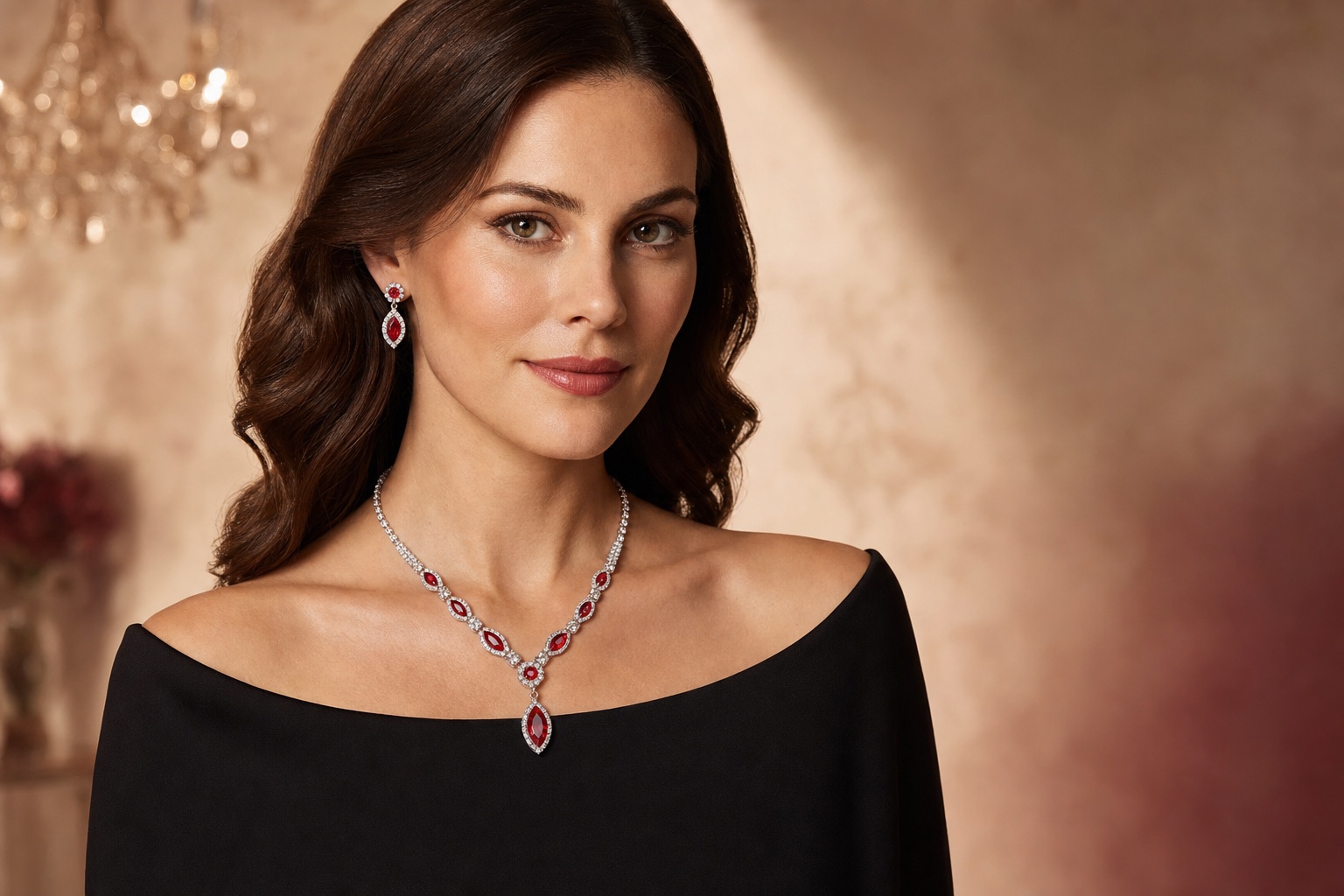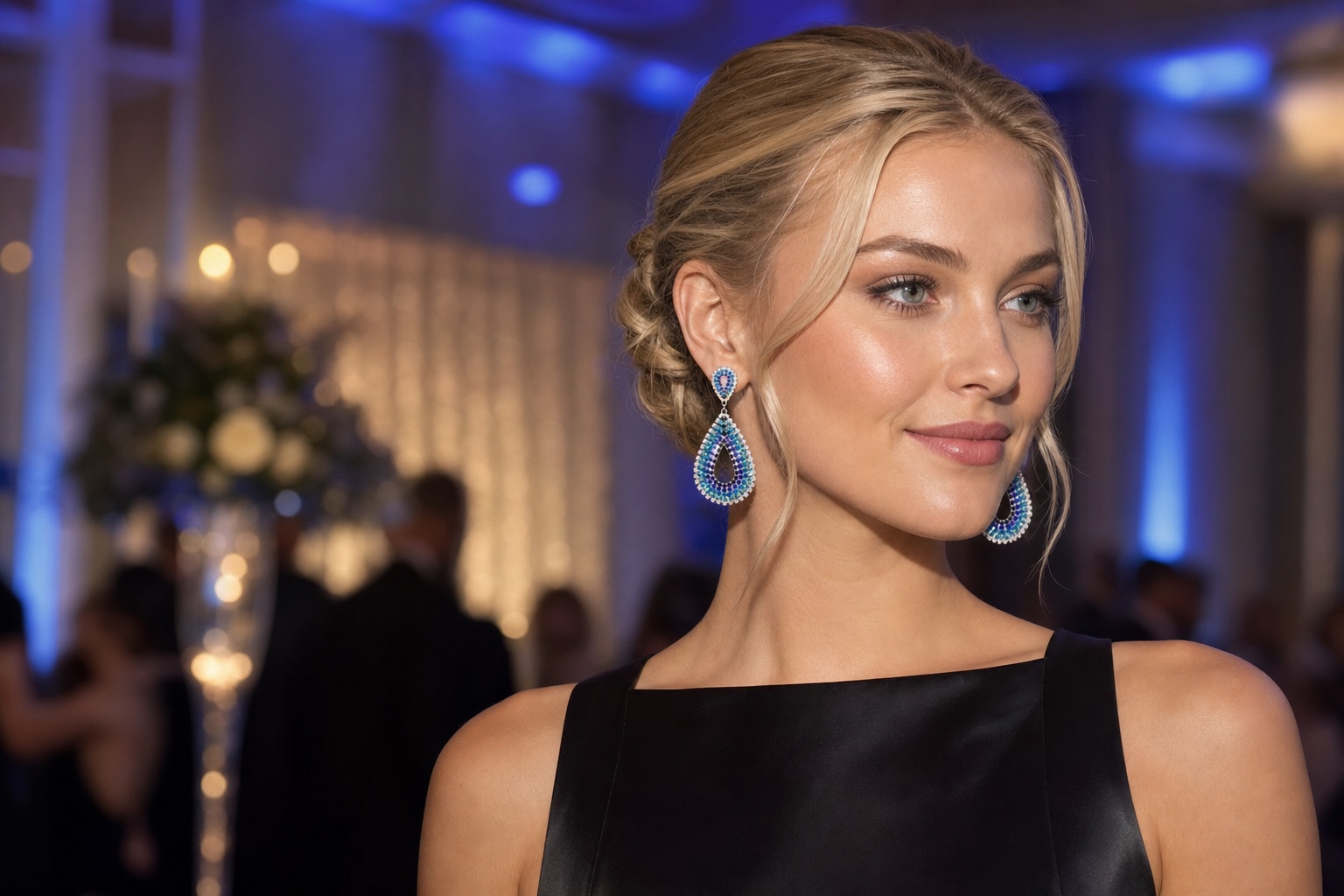
A prom jewelry order can look balanced on a spreadsheet and still fail on the selling floor. The problem is usually not a lack of sparkle. It is a mismatch between the jewelry and the dresses customers are actually trying on.
For a boutique buyer, the useful unit of planning is not “one necklace, one bracelet, one earring.” It is a dress-and-wearer decision: neckline, dress color, surface detail, hairstyle, comfort, budget, and the amount of visual emphasis the customer wants.
This guide turns those decisions into an assortment brief. It does not claim to predict best sellers. Current prom collections from brands such as Jovani, Sherri Hill, and Morilee are useful for observing the silhouettes presented to shoppers, but a brand catalog is a supply signal—not sell-through data. Your own dress receipts, try-on notes, reservations, and accessory attachments should decide the final buy.
Start with five dress facts
Before requesting jewelry samples, summarize the dress assortment in five fields.
| Field | What to record | Why it changes the jewelry brief |
|---|---|---|
| Neckline | Strapless, sweetheart, V-neck, off-shoulder, square, halter, high neck, asymmetrical | Determines whether the neckline has space for a necklace and what geometry will feel coherent |
| Dress color | Actual fabric swatch or approved color reference—not only a color name | “Navy,” “champagne,” and “emerald” vary across mills, screens, and lighting |
| Surface detail | Plain, satin sheen, sequins, beading, lace, dimensional floral, metallic | Helps prevent the dress and jewelry from competing at the same scale |
| Intended emphasis | Face, neckline, wrist, or complete look | Prevents every component from becoming a statement at once |
| Wear constraints | Hairstyle, pierced/non-pierced ears, sensitivity information, movement, garment snag risk | Filters out options that photograph well but are uncomfortable or impractical |
Do not translate these fields into rigid fashion rules. They are fitting-room prompts. A customer may deliberately choose contrast, mixed metals, or an unconventional proportion. The buyer’s job is to provide useful options and accurate information, not prescribe a single “correct” look.
Build coverage cells before choosing SKUs
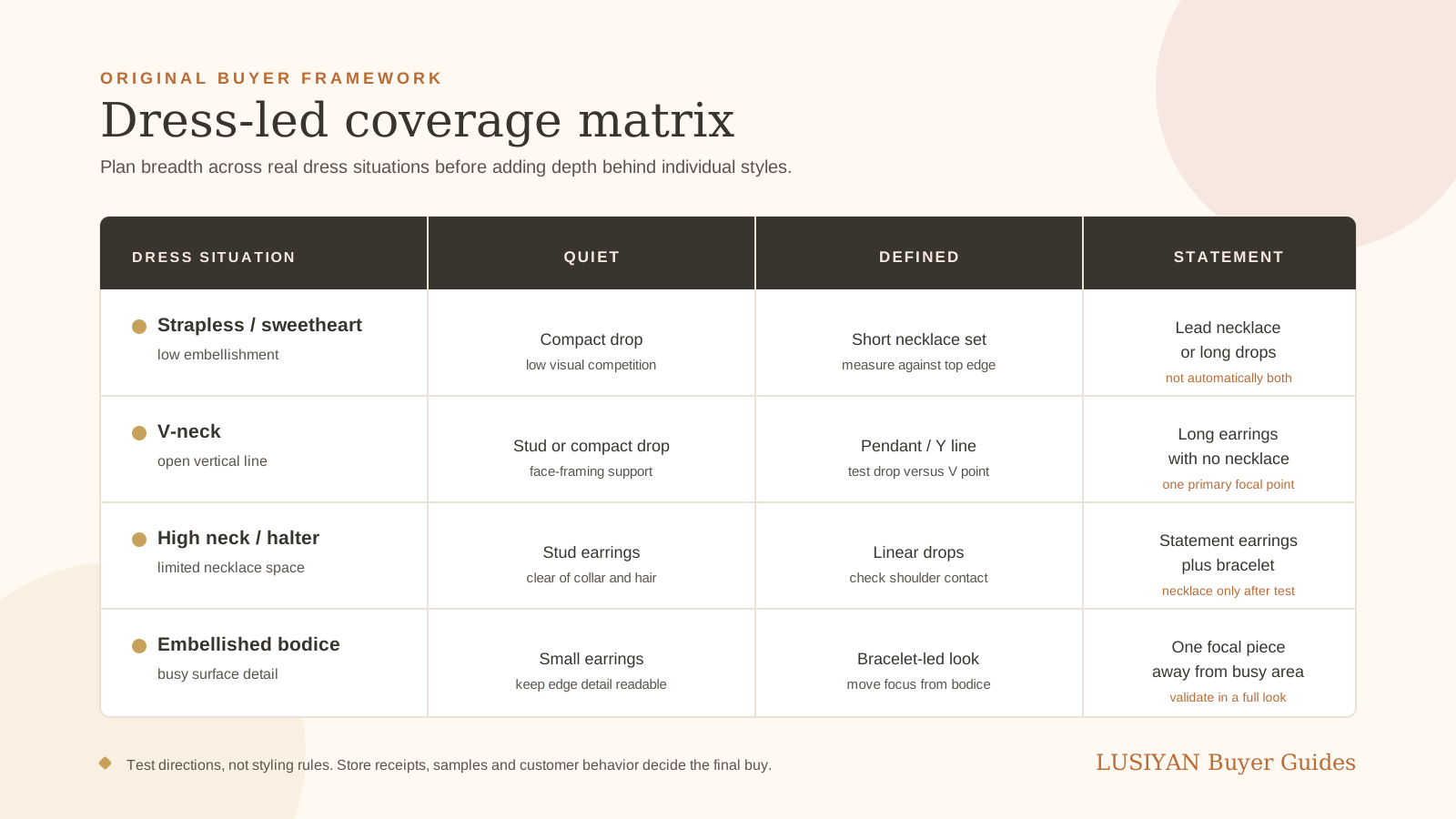
An assortment becomes easier to audit when it is planned as a set of coverage cells. A cell combines a dress situation with a jewelry role.
For example:
| Dress situation | Quiet option | Defined option | Statement option |
|---|---|---|---|
| Strapless or sweetheart, low embellishment | Small drop earrings | Short necklace set | Statement necklace or long drop earrings—not automatically both |
| V-neck, low embellishment | Stud or compact drop | Pendant/Y silhouette that follows the open line | Long earrings with no necklace |
| High neck or halter | Stud earrings | Linear drops | Statement earrings plus bracelet |
| Heavily embellished bodice | Small earrings | Bracelet-led look | One deliberate focal piece away from the busiest dress area |
| Asymmetrical neckline | Compact earrings | Bracelet or balanced drop | Test in person; avoid assuming mirrored geometry will work |
This is an editorial planning framework, not a law of styling. Its commercial value is that it exposes gaps. If twelve necklace sets cover one easy strapless-dress cell while high-neck dresses have no earring-led options, the order has depth without useful breadth.
For a more detailed way to normalize neckline labels and test product geometry, use the companion jewelry-for-dress-necklines buyer guide.
Treat breadth and depth as different decisions
Breadth is the number of distinct customer situations the assortment can answer. Depth is the number of sellable units behind an option.
Choose breadth first when:
- the boutique is still learning which dress and accessory combinations attach;
- the dress assortment changed substantially;
- a new finish, color family, or silhouette has not been tested;
- the supplier’s photographs do not answer scale, movement, or construction questions.
Choose depth only after there is evidence: repeated try-ons, reservations, actual accessory attachments, replenishment requests, or sales by a stable style. A low unit price is not evidence that a deep order is safe.
A practical pilot sheet can be as simple as:
| Coverage cell | Candidate style | Sample passed? | Opening units | Try-ons | Sales | Returns/issues | Reorder decision |
|---|---|---|---|---|---|---|---|
| High-neck / earring-led / silver tone | |||||||
| Strapless / quiet necklace set / warm tone | |||||||
| Embellished bodice / bracelet-led |
The opening-unit field should come from your store’s traffic, price points, lead time, and cash constraint. There is no responsible universal ratio for every boutique.
Specify appearance instead of relying on category names
Terms such as “crystal,” “rhinestone,” “silver,” and “gold plated” can be too broad for procurement. The U.S. FTC Jewelry Guides prohibit misrepresentation of a jewelry product’s type, quality, composition, and other material characteristics. Even when a particular legal rule does not apply to every fashion-jewelry component, the sourcing lesson is sound: request specific, supportable descriptions.
For each candidate style, ask for:
- base-metal description;
- stone or decorative-component identity;
- finish/plating description and, where relevant, thickness or process specification;
- dimensions and weight for each component;
- closure, post, clip, clasp, extender, and chain construction;
- color variants and an approved physical reference;
- sample status and whether the production unit will match it;
- packaging method and unit protection;
- MOQ, price basis, production lead time, and quote validity;
- test reports or declarations required for the destination market and intended wearer.
If a field is unknown, record it as unknown. Replacing a missing specification with a confident marketing adjective creates a future product-page problem.
Make the sample earn its place
A sample is not merely a miniature order. It is a decision instrument. Evaluate it under the conditions in which the customer will encounter it.
On the dress
- Photograph it against the actual fabric swatches and representative necklines.
- Check whether the jewelry disappears into dense embellishment or overwhelms a minimal dress.
- View it from fitting-room distance, conversation distance, and a phone camera—not only close-up.
On a person
- Record necklace drop, earring drop, bracelet fit range, and component weight.
- Check movement, twisting, clasp access, hair interaction, and garment snagging.
- Do not infer hypoallergenic or sensitivity performance from appearance. Obtain the relevant material and test documentation.
As a product
- Compare the physical sample with the supplier’s images and written specification.
- Inspect stone alignment, missing components, sharp edges, finish consistency, solder or joint areas, closures, pairs, and packaging abrasion.
- Keep one approved reference sample, labeled with supplier, style code, date, finish, and revision.
Keep the result in a reusable sample-evaluation record with photographs, measured datum points, the supplier style code, sample date, revision and pass/fail reason. That record should remain linked to the RFQ and approved reference sample.
Merchandise the decision, not just the object
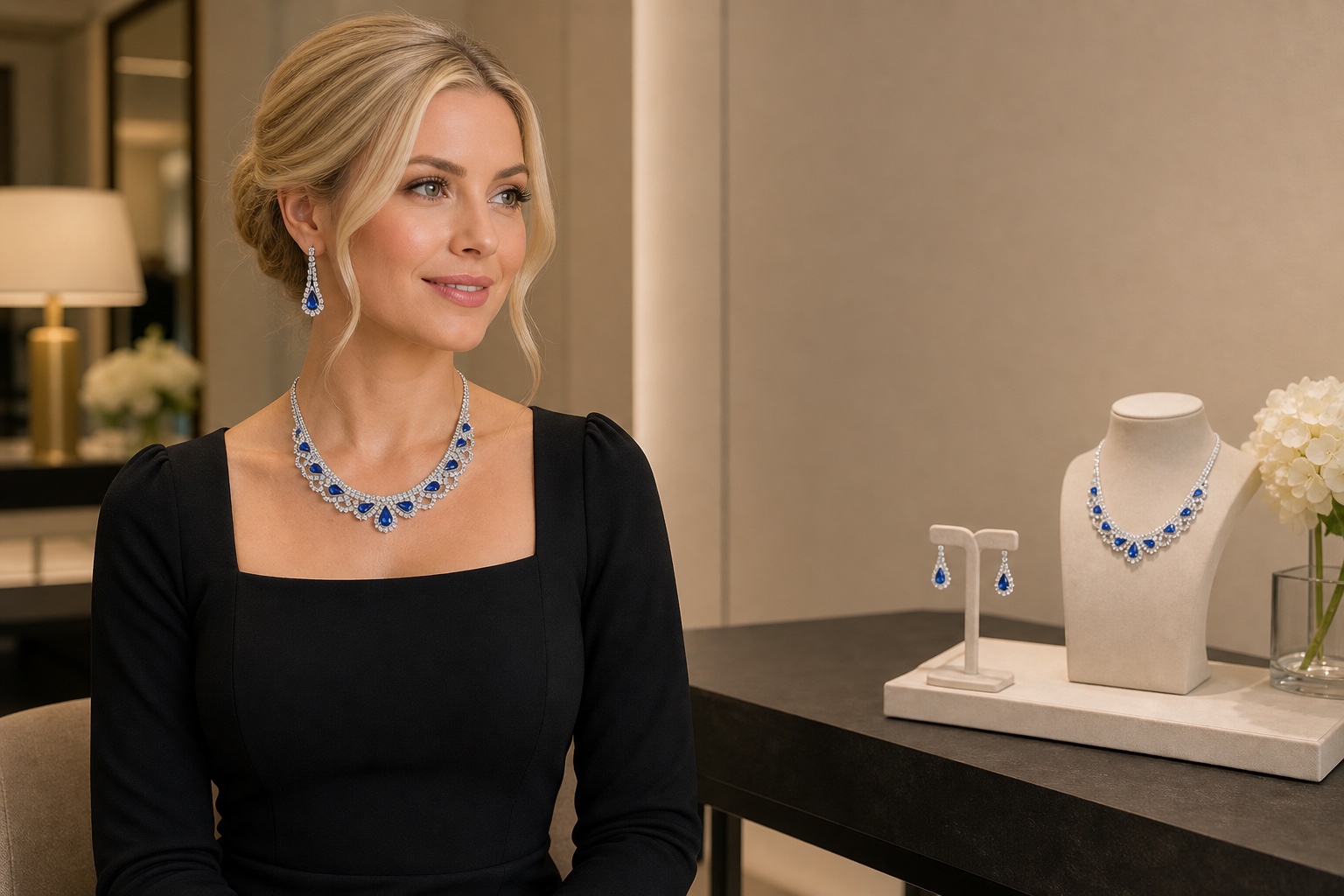
On the floor, a customer should be able to understand why an option is present. That can be achieved without turning a display into a rulebook.
Useful merchandising units include:
- one dress plus three levels of jewelry emphasis;
- one neckline shown with a necklace-led and an earring-led alternative;
- one dress color shown with tonal, neutral-metal, and deliberate-contrast options;
- a “complete the look” tray whose pieces are individually removable;
- a fitting-room card asking about hairstyle, comfort, and preferred focal point.
Keep finish names and material claims aligned with the product record. If the card says cubic zirconia, the SKU record and supplier evidence should say the same thing.
Measure what the assortment teaches you
Sales alone do not explain why an item did or did not work. During the season, capture a small set of operational signals:
- dress style or neckline tried with the piece;
- color/finish requested;
- try-on count;
- accessory attachment to a dress sale;
- reason declined, if volunteered;
- return or quality issue by SKU and lot;
- days from reorder request to usable stock.
Use those records to retire empty coverage cells, add depth where evidence repeats, and rewrite the next RFQ. Do not publish the resulting internal rate as a broad market statistic.
A concise wholesale prom jewelry brief
Before sending an inquiry, confirm that the brief answers:
- Which dress necklines and color families must be covered?
- Which looks need quiet, defined, and statement options?
- Which specifications are verified, pending, or unknown?
- Which samples must be worn, photographed, and compared?
- What is the target in-store date, including approval and shipping buffers?
- What evidence will trigger a reorder—or stop one?
That brief is more valuable than a long favorites list because it gives the supplier a solvable problem.
Build a selection for a real dress assortment
Explore LUSIYAN’s wholesale prom jewelry by category, color, occasion, and neckline, including the current Prom earrings, necklace sets, and bracelet edits. Add relevant styles to your selection, then request a wholesale proposal with the dress mix, target date, destination market, and specification questions attached. MOQ and availability vary by style and quotation.
Editorial note: This guide provides an assortment-planning method, not a sales forecast, legal opinion, or product-safety certification. Verify every SKU against current supplier documentation and the requirements of the market where it will be sold.